
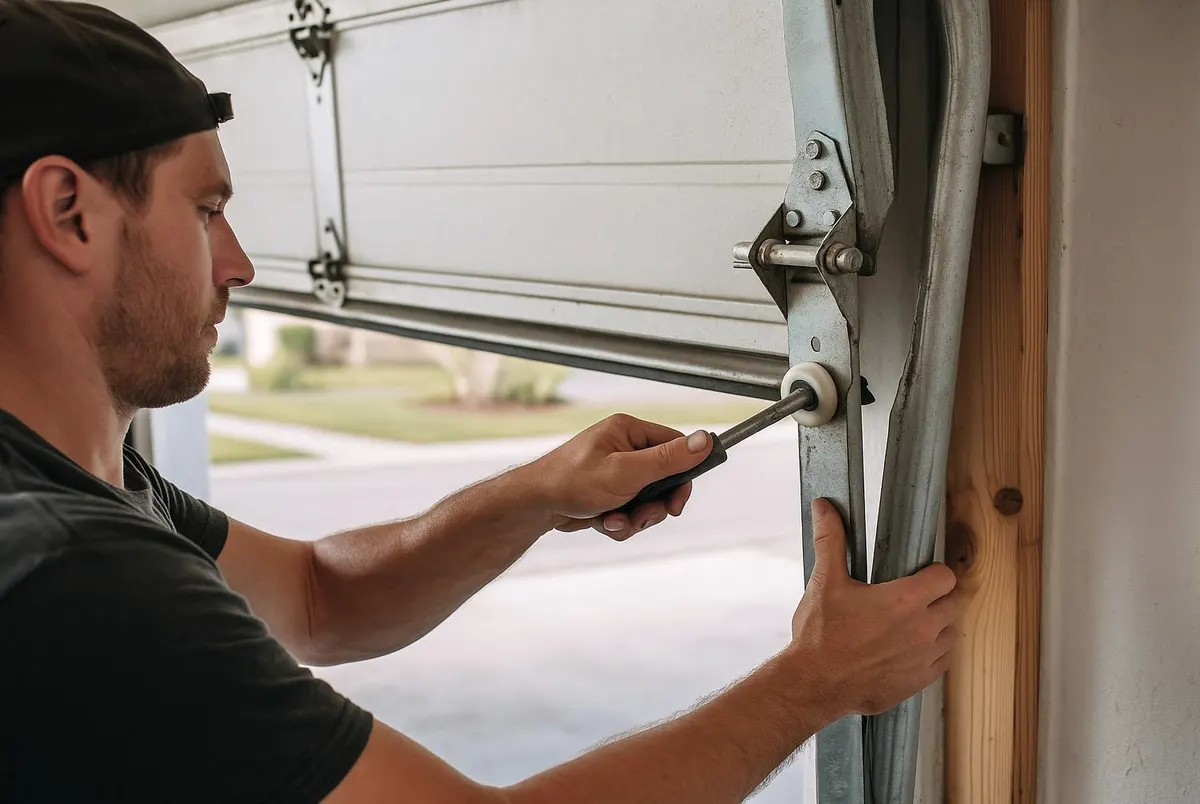
What a Service Call Usually Looks Like
Most calls start the same way: the homeowner says the door 'sounds different' and isn't sure if it's urgent. A technician usually starts by running the door up and down a few times while watching the springs, tracks, and rollers rather than just listening. In a place like Merritt Island, where salt air moves in off the water and humidity swings hard between afternoon downpours and dry heat, hardware wears unevenly compared to inland homes, so the noise often tells you where to look before any tool comes out.
Grinding
Grinding sounds like metal scraping metal, usually loudest right as the door starts moving or near the top of its travel.
- Rollers first: a tech checks the rollers for flat spots or dried-out bearings, since worn nylon or steel rollers grinding in the track is the most common cause.
- Opener gear second: if the rollers look fine, the drive gear inside the opener unit gets checked. These plastic gears wear down over years of use and grind as they slip.
- Track alignment last: bent or misaligned track sections force rollers to grind against metal they shouldn't touch. This is checked last because it's less common but more serious if ignored.
The fix for worn rollers is usually a straightforward roller replacement. A stripped opener gear means replacing that internal part or, if the opener is older, considering a full opener swap. Bent track requires loosening the mounting brackets and carefully re-aligning the rail, which should always be done by someone trained on spring tension.
Squealing
Squealing is a higher-pitched, often intermittent sound, usually worse on the first open of the day.
- Lubrication first: dry hinges, rollers, and the torsion spring itself are the number one cause. Humidity and salt air actually accelerate this because moisture washes grease off moving parts faster than it would inland.
- Bearing wear second: if lubrication doesn't quiet things down, the tech checks the bearings at each end of the torsion spring shaft for wear or pitting.
- Spring tension third: a spring under uneven tension can squeal as it coils and uncoils. This gets checked last because it means the spring may need replacing soon regardless of the noise.
A lubrication service is quick: a silicone-based garage door lubricant on hinges, rollers, and springs, not household oil, which attracts dust and grit. Worn bearings get replaced along with the roller or spring assembly they're attached to. Uneven spring tension usually means the spring is near the end of its life and should be scheduled for replacement before it fails outright.
Popping
Popping is a sharp, sudden sound, usually a single loud noise during opening or closing rather than a continuous sound.
- Spring stress first: a popping sound is often the torsion spring shifting or beginning to fail. Technicians check this first because a fully broken spring is a safety issue.
- Track separation second: a pop can also be the door hitting a gap where two track sections have pulled apart slightly, often from age or a hard impact.
- Panel flex third: on hot, humid days followed by sudden rain, panels (especially older wood composite ones) can expand and contract, creating a popping sound as they flex against the frame.
A stressed or broken spring needs full spring repair or replacement, done with the door secured and tension released safely. Separated track gets reseated and bolted back into alignment. Panel flex from humidity swings often means the weatherstripping or panel seals need attention, or in persistent cases, a panel replacement if the material has started to warp.
Rattling
Rattling is a looser, repeated sound through most of the door's travel, not just at one point.
- Loose hardware first: bolts on the track brackets, hinges, and roller brackets loosen over time from vibration. This is checked first because it's the easiest fix and the most common cause.
- Worn rollers second: rollers with play in them rattle as they move through the track, especially on older steel rollers that have lost their round shape.
- Wind and track gap third: on coastal properties, wind pressure against the door surface can cause a rattle along loose or worn track, which matters more here given wind-load considerations during hurricane season.
Loose hardware gets tightened during a standard tune-up. Worn rollers are swapped for new ones, nylon being a quieter and more corrosion-resistant option near the coast. If wind is the culprit, the track and the door's wind-load hardware get inspected together, since a rattling door under wind stress is worth addressing before storm season peaks.
When to Call Merritt Island Garage Door Service
A single quiet squeak after lubrication is fine to leave alone. But grinding that doesn't go away, any loud popping sound, or a door that rattles harder every week means something is wearing out. Merritt Island Garage Door Service handles these calls with Garage Door Spring Repair and Garage Door Tune-Up & Maintenance, checking rollers, bearings, track alignment, and spring tension in that order so nothing gets missed. We also handle Off Track Door Repair for doors that have shifted enough to bind or grind against the frame.
If your garage door in Merritt Island, Cocoa Beach, Cocoa, Rockledge, Cape Canaveral, Titusville, Satellite Beach, or Viera is making a noise that wasn't there last month, call Merritt Island Garage Door Service and we'll come take a listen.